FROM THE BEGINNING
THE FIRST REPUBLICAN
LEADING THE WAY ON
THE ISSUES
THE BULL MOOSE
REPUBLICAN WOMEN
THE REPUBLICANS TRIP
RENEWING THE PARTY
TURMOIL
A RENAISSANCE
THE REPUBLICANS LOOK TOWARD THE
FUTURE
From the Beginning
Abolishing slavery. Free speech. Women's suffrage. In
today's stereotypes, none of these sounds like a typical
Republican issue, yet they are stances the Republican Party,
in opposition to the Democratic Party, adopted early on.
Reducing the government. Streamlining the bureaucracy.
Returning power to the states. These issues don't sound like
they would be the promises of the party of Lincoln, the party
that fought to preserve the national union, but they are, and
logically so. With a core belief in the idea of the primacy of
individuals, the Republican Party, since its inception, has
been at the forefront of the fight for individuals' rights in
opposition to a large, bloated government.
The Republican Party has always thrived on challenges and
difficult positions. Its present role as leader of the
revolution in which the principles of government are being
re-evaluated is a role it has traditionally embraced.
At the time of its founding, the Republican Party was
organized as an answer to the divided politics, political
turmoil, arguments and internal division, particularly over
slavery, that plagued the many existing political parties in
the United States in 1854. The Free Soil Party, asserting that
all men had a natural right to the soil, demanded that the
government re-evaluate homesteading legislation and grant land
to settlers free of charge. The Conscience Whigs, the
"radical" faction of the Whig Party in the North, alienated
themselves from their Southern counterparts by adopting an
anti-slavery position. And the Kansas-Nebraska Act, which
allowed territories to determine whether slavery would be
legalized in accordance with "popular sovereignty" and thereby
nullify the principles of the Missouri Compromise, created a
schism within the Democratic Party.
A staunch Anti-Nebraska Democrat, Alvan E. Bovay, like his
fellow Americans, was disillusioned by this atmosphere of
confusion and division. Taking advantage of the political
turmoil caused by the Kansas-Nebraska Act, Bovay united
discouraged members from the Free Soil Party, the Conscience
Whigs and the Anti-Nebraska Democrats.
Meeting in a Congregational church in Ripon, Wis., he helped
establish a party that represented the interests of the North
and the abolitionists by merging two fundamental issues: free
land and preventing the spread of slavery into the Western
territories. Realizing the new party needed a name to help
unify it, Bovay decided on the term Republican because it was
simple, synonymous with equality and alluded to the earlier
party of Thomas Jefferson, the Democratic-Republicans.
On July 6, 1854, in Jackson, Mich., the Republican Party
formally organized itself by holding its first convention,
adopting a platform and nominating a full slate of candidates
for state offices. Other states soon followed, and the first
Republican candidate for president, John C. Frémont, ran in
1856 with the slogan "Free soil, free labor, free speech, free
men, Frémont."
Even though he ran on a third-party ticket, Frémont managed to
capture a third of the vote, and the Republican Party began to
add members throughout the land. As tensions mounted over the
slavery issue, more anti-slavery Republicans began to run for
office and be elected, even with the risks involved with
taking this stance.
Republican Sen. Charles Sumner of Massachusetts experienced
this danger firsthand. In May 1856, he delivered a passionate
anti-slavery speech in which he made critical remarks about
several pro-slavery senators, including Andrew F. Butler of
South Carolina. Sumner infuriated Rep. Preston S. Brooks, the
son of one of Butler's cousins, who felt his family honor had
been insulted. Two days later, Brooks walked into the Senate
and beat Sumner unconscious with a cane. This incident
electrified the nation and helped to galvanize Northern
opinion against the South; Southern opinion hailed Brooks as a
hero. But Sumner stood by his principles, and after a
three-year, painful convalescence, he returned to the Senate
to continue his struggle against slavery.
The First Republican
With the election of Abraham Lincoln in 1860, the Republicans
firmly established themselves as a major party capable of
holding onto the White House for 60 of the next 100 years.
Faced with the first shots of the Civil War barely a month
after his inauguration, preserving the Union was Lincoln's
greatest challenge--and no doubt his greatest achievement. But
it was by no means his only accomplishment.
Amid the fierce and bloody battles of the Civil War, the
Lincoln administration established the Department of
Agriculture, the Bureau of Internal Revenue and a national
banking system. Understanding the importance of settling the
frontier, as well as having a piece of land to call your own,
Lincoln passed the Homestead Act, which satisfied the former
Free Soil members by offering public land grants. Hoping to
encourage a higher level of education, Lincoln also donated
land for agricultural and technical colleges to the states
through the Land Grant College Act, which established
universities throughout the United States.
Fully sensitive to the symbolism of their name, the
Republicans worked to deal the death blow to slavery with
Lincoln's Emancipation Proclamation and the passage, by a
Republican Congress, of the 13th Amendment, which outlawed
slavery. Hoping to permanently turn back the Democratic
advance in the South, immediately after the Civil War the
Republican Congress continued to push through legislation to
extend the full protection of civil rights to blacks.
During Reconstruction, the mostly Democratic South, which had
seceded from both the Union and Congress, struggled to regain
its footing. Meanwhile, the Republicans took advantage of
their majority and passed several measures to improve the
quality of life for blacks throughout the entire Union. First
the Republicans passed a Civil Rights Act in 1866 recognizing
blacks as U.S. citizens. This act hoped to weaken the South by
denying states the power to restrict blacks from testifying in
a court of law or from owning their own property.
Continuing to take advantage of their majority, Republicans
proposed the 14th Amendment, which became part of the
Constitution in 1868, stating: "All persons born or
naturalized in the United States, and subject to the
jurisdiction thereof, are citizens of the United States and of
the state wherein they reside. No state shall make or enforce
any law which shall abridge the privileges or immunities of
citizens of the United States; nor shall any state deprive any
person of life, liberty, or property, without due process of
law; nor deny to any person within its jurisdiction the equal
protection of the laws."
That same year the Republican Congress also passed the
National Eight Hour Law, which, though it applied only to
government workers, brought relief for overworked federal
employees by limiting the work day to eight hours.
Leading the Way on the Issues
Some people have argued that Republicans fought to give blacks
equal rights and then the vote as a way of wresting control of
the South away from the Democrats. While it is true that
almost all blacks voted Republican, these were very dangerous
and controversial issues at the time. For whatever reason,
many Republican politicians risked their careers on that
period's "third rail" of politics and managed to not only
abolish slavery, but eventually even to establish a black's
right to vote as well. In fact, many blacks even held elected
office and were influential in state legislatures. And, in
1869, the first blacks entered Congress as members of the
Republican Party, establishing a trend that was not broken
until 1935 when the first black Democrat finally was elected
to Congress.
Meanwhile, Republicans continued being elected to the White
House. In 1868, Civil War hero Ulysses S. Grant won the
presidency easily and was re-elected in 1872. Although he
seemed a bit bewildered by the transition from the military
life of a general to being president, under Grant the
Republican commitment to sound money policies continued, and
the Department of Justice and the Weather Bureau were
established.
The Republicans in Congress continued to boldly set the
agenda, and in 1870 they proposed and passed the 15th
Amendment, which guaranteed voting rights regardless of race,
creed or previous condition of servitude. Setting another
precedent two years later, the Republican Congress turned its
sights toward women's issues and authorized equal pay for
equal work performed by women employed by federal agencies.
It was around this time that the symbol of the elephant for
the Republican Party was created by Thomas Nast, a famous
illustrator and caricaturist for The New Yorker. In 1874, a
rumor that animals had escaped from the New York City Zoo
coincided with worries surrounding a possible third-term run
by Grant. Nast chose to represent the Republicans as elephants
because elephants were clever, steadfast and controlled when
calm, yet unmanageable when frightened.
But, embracing a tradition established by George Washington
and the Republican Party, which had gone on record opposing a
third term for any president, President Grant did not run for
re-election in 1876. Instead, in one of the most bitterly
disputed elections in American history, Republican Rutherford
B. Hayes won the presidency by the margin of one electoral
vote. After the election, cooperation between the White House
and the Democratic-controlled House of Representatives was
nearly impossible.
Nevertheless, Hayes managed to keep his campaign promises. He
cautiously withdrew federal troops from the South to allow
them to shake off the psychological yoke of being a conquered
land, took measures to reverse the myriad inequalities
suffered by women in that period and adopted the merit system
within the civil service.
Not surprisingly, the Republican appeal held in 1880 when the
party won its sixth consecutive presidential election with the
election of the Civil War hero James A. Garfield and also
managed to regain small majorities in both the House and the
Senate. Following Garfield's assassination, Chester A. Arthur
succeeded to the Oval Office and, in 1883, oversaw the passage
of the Pendleton Act through Congress. This bill classified
about 10 percent of all government jobs and created a
bipartisan Civil Service Commission to prepare and administer
competitive examinations for these positions. As dreary as
this bill sounds, it was important because it made at least
part of the government bureaucracy a professional work force.
Suddenly the Republicans' fortunes changed, and embarking on a
decade-long period of quick reversals, the Republicans lost
the 1884 election. But by this time the party had firmly
established itself as a permanent force in American politics
by not only preserving the Union and leading the nation
through the Reconstruction, but by also striking a chord of
greater personal autonomy within the national psyche.
Yet while the presidency was regained for one term with the
1888 election of Benjamin Harrison, with the re-emergence of
the South from the destruction of the Civil War the
Republicans were shut out for the first time since the Civil
War in the election of 1892, as the Democrats won control of
the House, the Senate and the presidency.
Republican voters returned to their party with the 1896
election, electing William McKinley to the White House. His
term was the start of a consecutive four-term Republican
possession of the White House.
The Bull Moose
Assuming the presidency when McKinley was assassinated in
1901, President Theodore Roosevelt busied himself with what he
considered to be the most pressing issue, ensuring the
Republican principle of competition in a free market. To do
so, Roosevelt used the Sherman Anti-Trust Act, passed in 1890
under Republican President Benjamin Harrison, to successfully
prosecute and break up several large business monopolies.
In 1903, Roosevelt became involved with foreign policy,
supporting revolutionaries who then formed the Republic of
Panama. His actions in Panama resulted in the treaty that
permitted construction of the Panama Canal. In 1905,
Roosevelt--who popularized the West African phrase "Speak
softly and carry a big stick" to explain his view on foreign
policy--successfully negotiated the Treaty of Portsmouth,
ending the conflict between Russia and Japan. Roosevelt's
accomplishments as a peacemaker earned him the Nobel Peace
Prize and the distinction of being the first American to
receive this award.
Roosevelt easily won a second term and proceeded to continue
to stand by his principles. Roosevelt, who was constantly
bucking public prejudice, appointed the Cabinet's first Jewish
member, Oscar Strauss. Then, in 1906, after reading Upton
Sinclair's "The Jungle," Roosevelt instructed Congress to pass
laws concerning meat inspection and pure food and drug
legislation. Two years later he placed 150 million acres of
forest land into federal reserves and organized a National
Conservation Conference. Believing in the importance of work,
Roosevelt was also responsible for creating the Department of
Labor.
Although his immense popularity almost guaranteed that he
could be elected to a third term, following precedent,
Roosevelt retired, allowing William Taft to become the next
Republican to hold the presidential office.
Discord struck the Republican Party in the 1912 election as
Roosevelt, dissatisfied with President Taft, led his
supporters on the "Bull Moose" ticket against the president.
Playing to the advantage of a split Republican vote, as they
would again 80 years later, the Democrats won the election
with Woodrow Wilson. When Wilson ran for re-election in 1916,
he promised to keep the United States out of World War I. Yet
shortly after his re-election, the United States stepped onto
the European battleground and entered the war. By mid-1918 the
Republican Party won control of Congress as Wilson's
popularity began to wane because World War I dragged on.
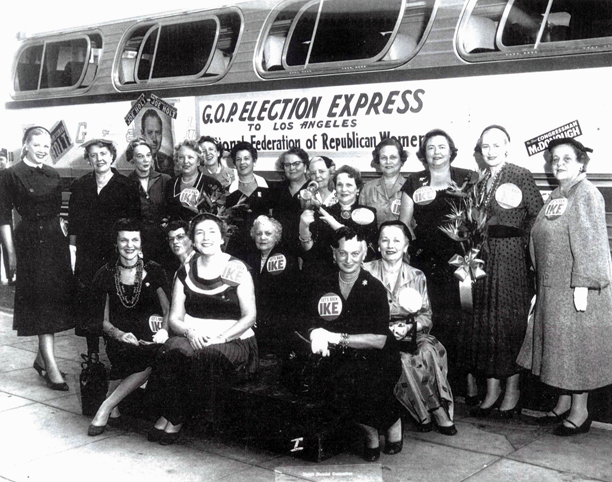
Republican Women
Standing in sharp contrast to the two existing political
parties' present stereotypes regarding minorities and women,
once again the Republican Party was the vanguard in relation
to women. In 1917, Jeannette Rankin, a Montana Republican,
became the first woman to serve in the House. Committed to her
pacifist beliefs, she was the only member of Congress to vote
against entry into both World War I and World War II.
Shortly after Rankin's election to Congress, the 19th
Amendment was passed in 1919. The amendment's journey to
ratification had been a long and difficult one. Starting in
1896, the Republican Party became the first major party to
officially favor women's suffrage. That year, Republican Sen.
A. A. Sargent of California introduced a proposal in the
Senate to give women the right to vote. The proposal was
defeated four times in the Democratic-controlled Senate. When
the Republican Party regained control of Congress, the Equal
Suffrage Amendment finally passed (304-88). Only 16
Republicans opposed the amendment.
When the amendment was submitted to the states, 26 of the 36
states that ratified it had Republican-controlled
legislatures. Of the nine states that voted against
ratification, eight were controlled by Democrats. Twelve
states, all Republican, had given women full suffrage before
the federal amendment was finally ratified.
The Republicans Trip
During the Roaring Twenties, three successive Republican
presidents kept a lid on government spending and taxes: Warren
G. Harding (1921-1923), who, according to "A Short History of
the American Nation," balanced the budget and reduced the
national debt by an average of more than $500 million per
year; Calvin Coolidge (1923-1929) and Herbert Hoover
(1929-1933), who was the last businessman to make the
successful transition to president.
While Republicans controlled the White House and Congress, the
U.S. economy expanded as free enterprise stimulated business
and industry. The Republicans' sound money policies brought
growing prosperity and steadily cut the federal debt.
In 1929, the Wall Street crash signaled disaster for the
Republicans as President Hoover emerged as the scapegoat for
the Great Depression. Despite his creation of the home-loan
banks and the Reconstruction Finance Corporation to save the
American financial structures, Hoover's anti-Depression
efforts went unheeded as people turned to the Democrats for a
"New Deal."
Under Franklin Roosevelt's New Deal, the federal government
gained power and size while deficit spending rose as a result
of increased government involvement in the economy.
Renewing the Party
The next 20 years were a time of rebuilding for the Republican
Party. This effort included establishing a greater role for
women. Launching a tradition that the RNC chairman and
co-chairman be of opposite sex, in 1937, Marion E. Martin was
named first assistant chairman of the Republican National
Committee. Three years later, the Republican Party became the
first major political party to endorse an equal rights
amendment for women in its platform.
In the post-Depression era, five presidential terms were
shared by only two presidents. The Democrats ignored the
two-term tradition upheld by the Republican Party and allowed
Roosevelt to run for and win an unprecedented four terms.
Following Roosevelt's death, Vice President Harry S Truman
became president. It was not until 1946, with the 80th
Congress, that the Republicans won a majority in both the
Senate and the House. Notably, it was this Congress that
produced the first balanced federal budget since Republican
Herbert Hoover was president.
With the Truman Administration held responsible for failure to
arbitrate a crippling steel strike, escalating inflation and
the Korean War, in 1950 the renewed Republican Party made
strong gains in Congress.
Two years later World War II hero Dwight D. Eisenhower was
elected president, carrying the party to its first
presidential victory in almost 25 years. During Eisenhower's
two terms, the nation quickly recovered from the economic
strain of the war. Focusing on rebuilding the nation and
re-establishing its pre-eminence, as well as his party's, he
established the Interstate Highway System and forged ahead
with America's space exploration program. Continuing the
Republicans' commitment to women, in 1953 he appointed a
woman, Oveta Culp Hobby, as the first secretary of his newly
created Department of Health, Education and Welfare.
The Eisenhower administration also made special efforts to
enforce the 1954 Brown vs. Board of Education Supreme Court
decision that declared "separate but equal" school
accommodations unconstitutional. On the heels of implementing
this decision through the protection of the National Guard,
Eisenhower completed formal integration of blacks in the armed
forces. Charged with upholding the rights of blacks,
Eisenhower appointed a Civil Rights Commission and created a
civil rights division in the Justice Department.
All of these actions culminated in the Civil Rights Act of
1957, which gave the attorney general power to obtain
injunctions to stop Southern registrars and officials from
interfering with blacks seeking to register and vote.
Turmoil
Eisenhower's vice president, Richard Nixon, lost the 1960
presidential election to John F. Kennedy by the narrowest
margin in U.S. history, and, with the establishment of the
Camelot mystique, it seemed the Republican Party was again at
an ebb in the political tide. Yet four years later, Sen. Barry
Goldwater emerged to revitalize the grassroots strength of the
GOP with his energy and his laissez-faire principles, and
despite losing the presidential election to Lyndon B. Johnson,
the Republican Party slowly re-established itself.
In 1968, Nixon led the party to victory in a hard-fought
presidential contest. In the next four years, Nixon
established his place in history as an expert in foreign
affairs. He firmly believed that the United States had a form
of government that was better than any other system, and
therefore, the United States should play a major role in world
politics in order to protect American interests as well as to
promote our values.
He opened relations with mainland China, which not only led 20
years later to a major market for American products but also
fundamentally altered the Cold War strategic balance. He ended
the U.S. involvement in Vietnam--a war that had torn this
country apart. He dramatically improved American security
through his policy of detente with the USSR, which led to the
signing of the ABM and other arms control treaties.
Domestically, Nixon brought inflation under control by
implementing the traditional Republican policy of fiscal
control and by the innovative tactic of cutting the dollar
loose from the gold standard. In addition, The Clean Air Act,
which began the process of environmental controls in the
United States, was crafted and passed under the Nixon
administration. His administration also promoted America's
manned space program.
Nixon won a landslide victory in 1972, carrying every state
except Massachusetts. In 1973, Spiro Agnew resigned as vice
president while under investigation for corruption during his
term in the 1960s as county executive of Baltimore County, Md.
Using provisions of the 25th Amendment, President Nixon
appointed House Republican Leader Gerald R. Ford to the vice
presidency. When Nixon resigned in the wake of the Watergate
scandal in 1974, Ford assumed the presidency, selecting former
Gov. Nelson Rockefeller as his vice president.
Under the Ford Administration, the United States regained its
confidence in politics and in the integrity of national
government. At the same time, America's double-digit inflation
rate was cut in half, taxes were cut significantly and the
role of municipal and state governments was enhanced by
reducing federal government expansion. However, the country's
first appointed president was denied election to office in
1976 by a narrow loss to Jimmy Carter.
A Renaissance
In 1980, Ronald Reagan ran for president promising a "New
Federalism." On the theory that local governments reflected
both the will and the wisdom of the citizenry better than the
remote bureaucracy-ridden government in Washington, Reagan
planned to transfer some functions of the federal government
to the states.
Both the past and the future of the Republican Party were
represented in Reagan's election to the presidency. Appealing
to the same conservative constituency that had been attracted
to Barry Goldwater, he also captivated a broad spectrum of
America with his easygoing and reassuring manner. His sense of
humor lightened the pessimism pervading America--as when John
Hinckley Jr. shot him in the chest. Although seriously
wounded, as Reagan was wheeled into the operating room for
emergency surgery, he told the team of doctors that he hoped
they were all Republicans.
His sincerity and strength led to an emotional tidal wave at
the polls. Reagan restored America's pride in itself. As he
once commented, "America's best days are yet to come. Our
proudest moments are yet to be. Our most glorious achievements
are just ahead. America remains what Emerson called her 150
years ago, 'The country of tomorrow.' What a wonderful
description and how true."
Continuing the Republican tradition of leading the way in
furthering the position of women, Reagan's first term included
several notable appointments. He selected Sandra Day O'Connor
as the first female Supreme Court justice, Elizabeth Dole as
the first female secretary of transportation and Jeane
Kirkpatrick as the first female U.S. representative to the
United Nations. With Dole, Kirkpatrick and Margaret Heckler as
the secretary of health and human services, it was also the
first time in history three women served concurrently in a
president's Cabinet.
In his 1984 re-election, President Reagan received the largest
Republican landslide victory in history. Under the leadership
of President Reagan and his successor, George Bush, the United
States experienced the longest economic expansion period in
its history--more than 20.7 million new jobs were created as a
result. His steadfastness in the face of the communist threat
led to the surprising--to all but himself--collapse of
communism in 1989. Reaching milestones economically and
diplomatically, President Reagan, "The Great Communicator,"
earned his place in history among our greatest presidents.
Although Reagan was a hard act to follow, President Bush's
leadership was proven when he lay a solid groundwork for U.S.
policy in such critical areas as nuclear disarmament, free
trade, the Middle East peace process and the future of NATO.
Relying on his illustrious military experience, he brought
together an unprecedented coalition to maintain the forces of
law in the Persian Gulf region. In the wake of Operation
Desert Storm, President Bush's popularity soared to record
levels. As a result of his leadership after the war, a
delegation from Israel sat face to face with Palestinians for
the first time in thousands of years.
Unfortunately President Bush was blamed for a worldwide
economic slowdown triggered by the collapse of the Soviet
Union and involving the transition of the global economy from
an industrial base to a high-technology base, and he was
unsuccessful in his bid for re-election in 1992. Nearly 20
percent of voters were drawn to the blunt anti-government
candidacy of Ross Perot, and another 43 percent elected "New
Democrat" Bill Clinton, who promised to reinvent government.
The Republicans Look Toward the Future
After Haley Barbour's election as chairman of the Republican
National Committee in January of 1993, the party began
concentrating on organizing its grassroots strength. Focusing
on the principles that had historically made the Republicans a
strong party, Barbour emphasized individual freedom, personal
responsibility and reduced government.
As a result of that work, House Republican members and
candidates together created the Contract With America, a bold
agenda of 10 specific pieces of legislation based on
Republican principles of individual liberty, economic
opportunity, limited and effective government, personal
responsibility and strong security. All told, 367 candidates
signed the Contract With America to bring fundamental change
to the way business is conducted in the people's House of
Representatives.
On Nov. 8, 1994, the American people responded to the
Republican promise of concrete change and voted for a new
American majority in the greatest midterm majority swing of
the 20th century. After 40 years of a Democratic-controlled
Congress, Republicans gained majorities in both the House and
Senate, as well as a majority of the states' governorships for
the first time in two decades. Not a single incumbent
Republican governor, senator or representative lost.
The swearing in of the 104th Congress marked the start of the
process of change embodied in the Contract With America. For
example, Republicans have made Congress abide by the same laws
it imposes on the rest of us; commissioned the first
independent audit of the Congress in history; cut Congress'
budget by at least 10 percent--more than $200 million;
eliminated three congressional committees, 25 subcommittees
and one of every three committee staff jobs; imposed term
limits on committee chairs and the speaker; planned a balanced
budget reducing the deficit to zero in seven years without
raising taxes; and worked to protect, preserve and improve
Medicare.
The actions of the 104th Congress not only promise to
fundamentally alter the way that Washington, and indeed the
nation, works, they also signal the continuation of a long
Republican history of offering fresh ideas and principled
approaches to the challenges facing our nation.
Source: The Republican National Committee,
www.rnc.org
|